AI · 6 min read · 2026-10-13
You Don't Need an AI Website. You Need a Website Built With AI.
The floor came up. The ceiling didn’t move. Why "AI built my website" and "built with AI" are two different products — and what the difference costs.
There's a difference, and it's costing business owners real money.
Right now every platform on the market is running the same ad: describe your business in a sentence, watch a website appear. And to be fair, the output is getting good. Two years ago these tools produced obvious garbage. Today they produce something that looks like a website — clean type, decent spacing, a hero image that isn't embarrassing.
That's exactly the problem. The floor came up. The ceiling didn't move.
A prompt is not a strategy
When you type "make me a website for my plumbing company," the machine doesn't know what you didn't say. It doesn't know that 70% of your revenue comes from emergency calls and your phone number needs to be the loudest thing on the page. It doesn't know you serve eleven suburbs and a single generic "service area" line is going to cost you visibility in nine of them. It doesn't know your competitor already owns the keyword you should be building around.
It can assume. That's the whole trick — it's very good at filling gaps with the most statistically reasonable guess. And we all know what happens when people assume.
It gives you what you asked for. You asked for a website. You got a website.
What you needed was a customer acquisition asset, and those two things are only related by accident.
This is the part that gets skipped in every demo: the quality of an AI-built site is capped by the quality of the brief. If you don't know what you need, you can't ask for it, and a system that's designed to say yes will never tell you that you asked the wrong question.
Ignorance doesn't have a seat at the table in emerging tech
That sounds harsh. I mean it structurally, not personally.
In a mature technology, the guardrails are baked in. You can't easily wire a house wrong anymore because the breaker panel, the code, and the inspector all catch you. Emerging tech has none of that. There is no inspector for your website. Nothing stops a generated site from shipping with:
- Broken or duplicated meta structure — multiple H1s, missing titles, boilerplate descriptions repeated across every page. Search engines read this as a site with nothing to say.
- Thin or hallucinated content — service pages that describe services you don't offer, or copy so generic it's indistinguishable from ten thousand other sites in your vertical.
- No crawl logic — orphaned pages, no internal linking, a sitemap that doesn't match reality.
- Compliance exposure — no accessibility considerations, no privacy policy that matches what your forms actually collect, stock photos with unclear licensing.
- No conversion path — a beautiful page with nowhere to go.
Any one of these is fixable. Shipped together, unnoticed, for eight months, they don't just fail to help you. They actively teach Google that your business isn't worth surfacing. You can do more damage than having no website at all, because "no website" is neutral and "bad website" is a signal.
The companies selling this know
Let's be honest about the other half of the equation. Plenty of these products are being pushed to market unpolished and unrefined, because the race for market share is worth more to the vendor than your outcome. The pitch is speed and price. Nobody's incentive is aligned with you finding out, two quarters later, that your site never had a chance.
That's not a reason to reject the tools. It's a reason to stop treating them as a replacement for knowing what you're doing.
What "built with AI" actually looks like
Here's how we use these same technologies, and why the result is different.
We start with the question the AI can't ask. What are we actually trying to make happen? Calls? Booked appointments? Qualified form fills from a specific zip radius? That answer determines the architecture before a single page is generated.
We bring the research to the prompt. Keyword landscape, competitor structure, what's actually ranking for the terms that matter, what the customer is typing when they're two minutes from buying. AI is extraordinary at execution against a good brief and useless at knowing whether the brief is good.
We use AI where it's genuinely superior. First-draft copy at volume. Schema markup. Alt text across two hundred images. Variant testing. Technical audits. These are tasks where the machine outperforms a person and does it in a fraction of the time — and that's real, that's not hype.
We keep a human on the judgment. Someone has to decide what's true, what's on-brand, what's legally defensible, and what will actually make a person pick up the phone. That's not a prompt. That's experience. We even built our shop around the split: HANS, our AI, does the heavy lifting, and HALO — the ring of human judgment we draw around everything it produces — means a person approves what ships. Machines propose. People decide.
We ship, then we measure. A site is a hypothesis. The tools let us test and iterate faster than we ever could before, which is the actual revolution here — not the generation, the iteration.
Three sites, built this way
Here are three sites we built exactly this way — our own, our family brand, and a client's. Hover a site to scroll it top to bottom; point at any line below it and the page glides to that spot.
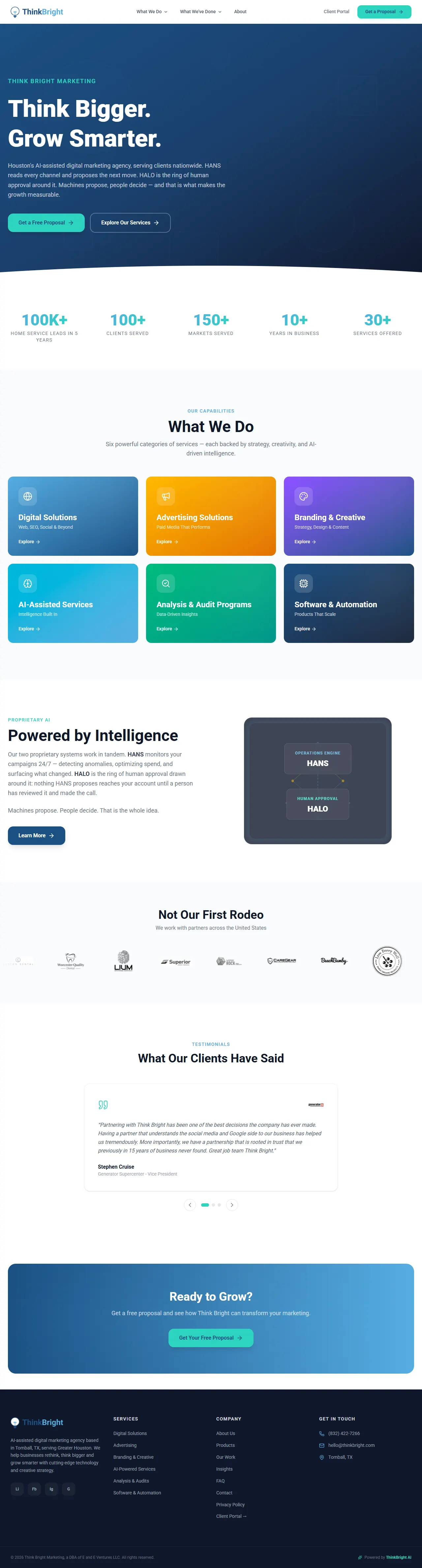

- The page arrives already built. Every page is pre-rendered to plain HTML, so a phone, a search engine or an AI agent reads the real content without waiting on code to run.
- Fast where it counts. On a simulated phone over a slow mobile connection, the main content is on screen in under four seconds — and on desktop the site scores 98 out of 100 on Google's own speed test.
- Machines propose, people decide. HANS does the heavy lifting; HALO — a person — approves what ships. The site runs the way it describes.
- Nothing to break into. No WordPress login, no plugins to patch. HTTPS is enforced, the site can't be framed by another page, and the browser grants exactly one permission: the microphone, because every form field takes dictation.
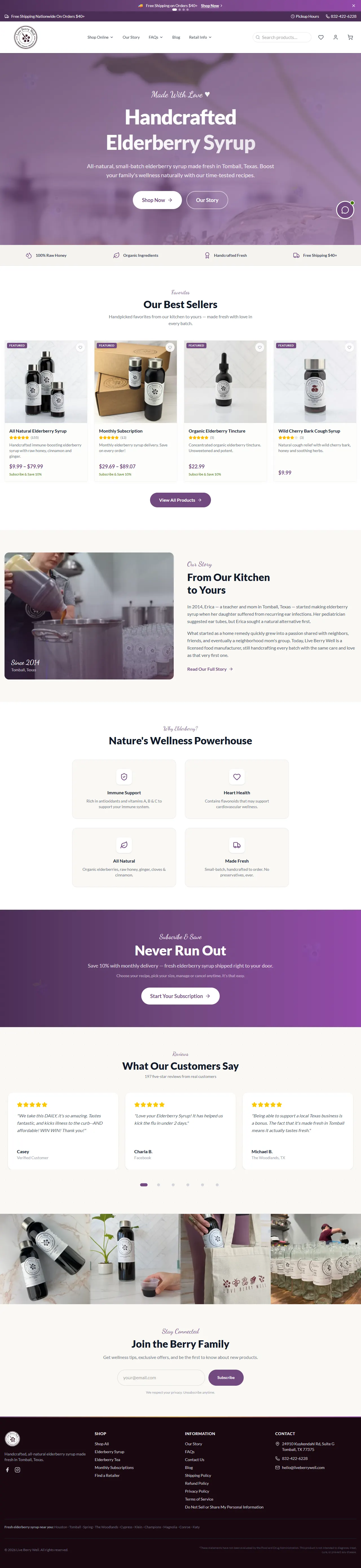

- A real store, not a template. Cart, checkout, subscriptions and order tracking — moved off WooCommerce with all 189 customer reviews and every live subscription intact.
- Card numbers never touch the site. Payment fields are served by Braintree, the processor, inside their own secure frames. The store never sees or stores a card.
- The browser only runs what we approved. A strict content policy lists every service the store may load code from, and the site refuses to be framed by anyone else's page.
- A full store that still loads fast. The page appears before any of the shop's code runs — cart, checkout and the Liv assistant load right behind it. On desktop it scores 98 out of 100 on Google's speed test, and on a phone the main content is up in about three seconds.
- Reviews are real, and kept. The 189 reviews came across from the old store word for word.
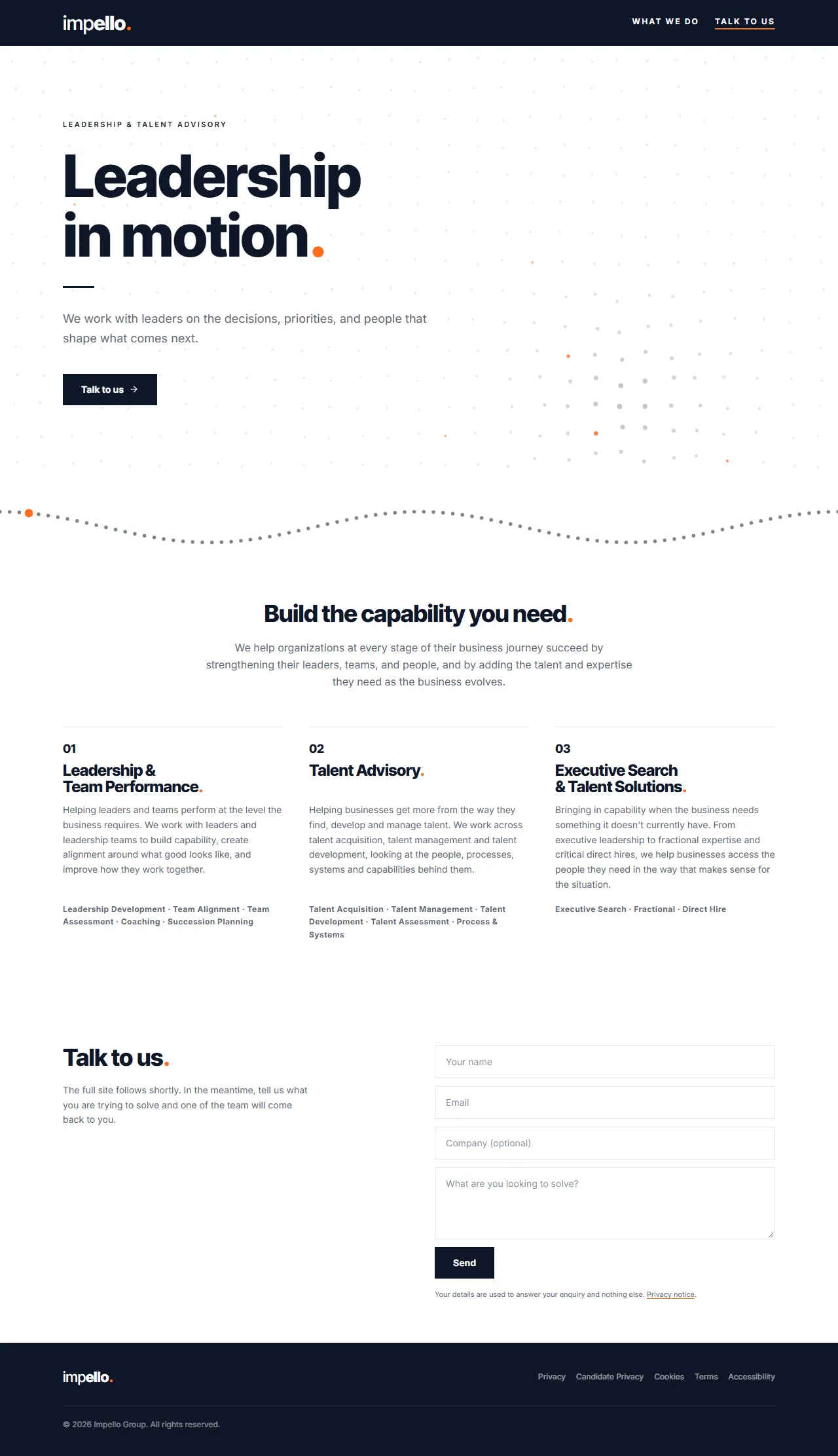

- Built for the person reading it. A leadership and talent advisory for boards and founders: one page that states the offer plainly and puts a direct line in front of you.
- Light and fast. The page loads only what it shows, and its typefaces come from its own server, not a third party — a perfect 100 on desktop in Google's speed test.
- AI drafts. The founder decides. The site's writing tools work in the founder's own voice and only ever propose: nothing changes until he approves it, and no version is ever overwritten.
- The form asks only for what it needs. Name, email, the problem — used to answer the enquiry and nothing else, on a page that can't be framed by anyone else's.
Speed scores are Google Lighthouse, the industry's standard lab test: median of three runs per device, October 2026.
We built this argument into a product
For a long time the honest ending to this article was "find someone who knows what to ask for." It's still true. But we got tired of the industry having no inspector, so we built one into the process.
It's called Think Bright Sites, and it's live in beta. It doesn't start from a prompt — it starts from your existing site, because the brief problem is the whole problem. Paste your URL and we rebuild what you already have, row by row, on a lightweight page system: your headline, your services, your photos, your phone number, your reviews. You see the match before anything changes. Then you pick a look, edit in place or by voice note, and review it on a private link for seven days before it goes live on your own domain — a domain you keep.
And the machinery runs exactly the way this article says it should: HANS does the work, and a person reviews every change before it ships. If your current site already passes, we'll tell you that instead.
The takeaway
The tools are real. The gains are real. We use them every day and our clients benefit from them every day.
But "AI built my website" and "my website was built with AI" describe two completely different products. One is a lottery ticket. The other is a strategy executed at a speed that wasn't possible three years ago.
If you don't know what you don't know, the fastest path to a website is also the fastest path to an expensive problem. Find someone who knows what to ask for — or start where the asking is already done: the site you have today.
Think Bright Marketing builds websites and marketing programs designed around what your business actually needs to happen. If you'd like a straight assessment of whether your current site is helping or hurting you, get in touch — or see your site rebuilt at Think Bright Sites, free to preview, live in beta.